East Asia’s Troubled Democracies: How Illiberal Trends Are Reshaping Politics in Japan, South Korea, and Taiwan
(Columbia University Press, forthcoming 2026)
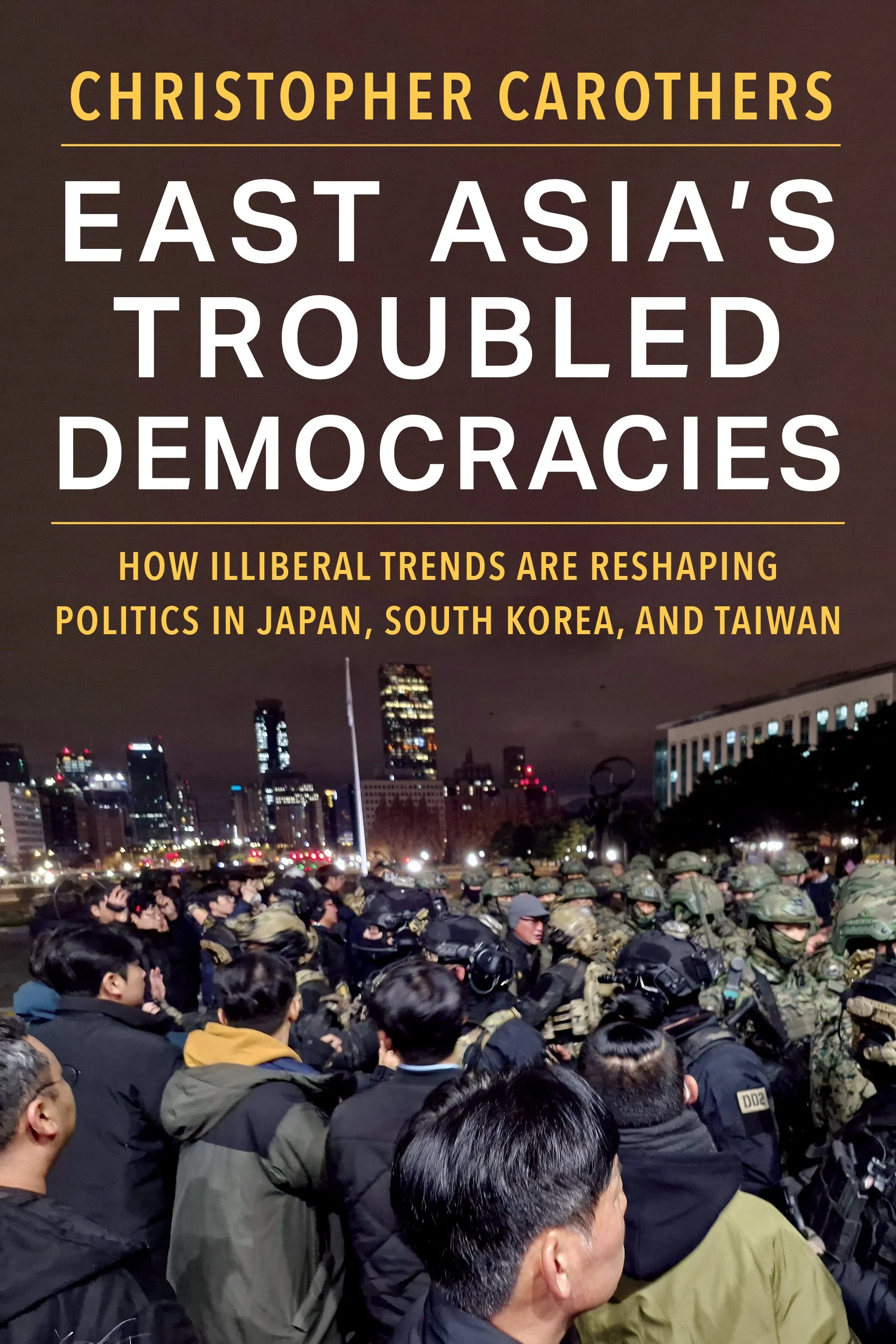
Amid global concern over democratic backsliding, Japan, South Korea, and Taiwan are often viewed as exceptions--stable, healthy democracies. Yet illiberal trends have been quietly growing in each country since the early 2010s. South Korea's martial law crisis in December 2024 shocked the world, and all three East Asian democracies face rising threats to elections, the rule of law, and civil and political rights.
Drawing on extensive multilingual research, Christopher Carothers traces the forces undermining democracy in Japan, South Korea, and Taiwan. East Asia's Troubled Democracies identifies the crucial factor fueling challenges in each country: the overcentralization of power in Japan, political polarization in South Korea, and Beijing's interference in Taiwan. In addition, all three countries have seen rising immigration, changing norms around gender and sexuality, and shifting views of national identity since the 1990s. This rapid sociocultural change has provoked political backlash, straining democratic norms. At the same time, as Carothers shows, historical, institutional, and demographic characteristics shared across these three societies have bolstered democratic resilience.
Compellingly written and rigorously argued, this book provides a nuanced corrective to overly optimistic views of the state of democracy in East Asia and reveals how global trends in democratic erosion are playing out in this critical region.
Praise:
“East Asia’s Troubled Democracies is an impressive work of deep and nuanced comparative analysis that should be essential reading for not only regional specialists but also scholars around the world seeking to understand the sources of contemporary democratic decay and resilience. In exposing the distinctive syndromes of democratic stress in Japan, Korea, and Taiwan and the common features of developmental success that have so far contained democratic backsliding in the face of external threat and sociocultural change, Carothers makes a theoretically significant and empirically rich contribution to the literature on global democracy.” — Larry Diamond, author of Ill Winds: Saving Democracy from Russian Rage, Chinese Ambition, and American Complacency
“East Asia’s Troubled Democracies is a highly original, carefully researched and argued contribution to the study of democratic backsliding around the world. This book will be especially valuable to anyone working on the drivers of democratic regression and to scholars focused on politics, elections, and parties in Japan, South Korea, and Taiwan.” — Kharis Templeman, author of Dynamics of Democracy in Taiwan: The Ma Ying-jeou Years
“Through rich and nuanced comparative research, Carothers diagnoses what ails democracy in Japan, South Korea, and Taiwan. This ambitious book addresses a key challenge of our time—democratic backsliding—while also providing readers with the tools for identifying and assessing each country’s unique symptoms and their etiology.” — Celeste L. Arrington, author of From Manners to Rules: Advocating for Legalism in South Korea and Japan
Corruption Control in Authoritarian Regimes: Lessons from East Asia
(Cambridge University Press, 2022)

This book challenges the conventional wisdom that autocrats have little incentive or ability to combat corruption by showing that meaningful anti-corruption efforts by authoritarian regimes are more common and more often successful than is widely assumed. Although anti-corruption efforts often have multiple goals, autocrats are most likely to undertake clean-ups when they have ambitious state-building agendas that corruption threatens to undermine. I argue that such efforts are likely to succeed when autocrats are motivated to curb corruption, have broad discretionary power over the operations of the regime, and have sufficient state capacity to implement reforms. Whereas institutional constraints on power are critical for reducing corruption in democracies, the success of authoritarian corruption control often depends on a powerful autocrat having a free hand to enact and enforce measures curbing government wrongdoing. These and other findings are based on a systematic analysis of authoritarian anti-corruption efforts globally since 1950 and deeply researched case studies of China, South Korea, and Taiwan across multiple decades. The book advances our understanding of authoritarian governance and durability and opens up new avenues of inquiry about the politics of corruption control in East Asia and beyond.
Reviewed in: China Quarterly, Foreign Affairs, APSA – Democracy and Autocracy, Developing Economies, New Books Network.
Praise:
“In this provocative, well-researched and wide-ranging book, Carothers shows that autocratic efforts to control corruption are more common, occur for different reasons, and are more often successful than we think. His analysis of anti-corruption drives by different leaders in Taiwan, South Korea, and China sheds new light on the history and contemporary politics of all three places, and his identification of a distinctly authoritarian anti-corruption model is theoretically path-breaking as well as policy-relevant. This challenge to the conventional wisdom deserves to be read carefully, by scholars and policymakers alike.” – Sheena Chestnut Greitens, University of Texas at Austin
“Carothers has written an important book challenging the conventional wisdom that there is a necessary connection between authoritarian government and political corruption. Through both a quantitative analysis and historical case studies, he shows that a number of authoritarian regimes, including Xi Jinping's China, have succeeded in reducing levels of corruption. Highly recommended for both China specialists and governance studies.” – Francis Fukuyama, Stanford University
“Corruption Control in Authoritarian Regimes addresses the classical question of whether dictatorships can curb the predatory behavior of their agents. Carothers’ invaluable comparative study of how three dictatorships in East Asia tackled corruption provides an original and persuasive answer. This book is a major contribution to the literature on corruption in general, and on the political economy of authoritarianism in particular.” – Minxin Pei, Claremont McKenna College
“In a field that is obsessed with showing the obvious, a counterintuitive argument, like the one that autocrats can fight corruption, is both rare and noteworthy.” – Martin Dimitrov, Tulane University
“Shows that autocrats can be effective corruption fighters, provided they are advancing a state-building or revolutionary project that requires cleaning out the bureaucracy, exercising unconstrained personal power, and relying on party or state institutions strong enough to carry out their will.” – Andrew Nathan, Foreign Affairs
"Corruption Control in Authoritarian Regimes is a thought-provoking book that breaks new ground in the study of authoritarianism.” – Yoshinori Nishizaki, National University of Singapore
“Carothers breaks open the black box of authoritarianism to provide much needed insight into the politics of corruption. Whether one wants to learn more about political development and durability in East Asia, or when, how, and why autocrats curb corruption more generally, this book delivers.” – Karrie J. Koesel, University of Notre Dame